When a couture dress holds a sculpted hip, a crisp bodice, or a dome-like skirt that seems to defy gravity, the credit belongs to elements the viewer never sees. Haute couture silhouettes are engineered from the inside out using three categories of internal structure: rigid supports like boning and wire, shaping layers like interlinings and underlinings, and volume creators like padding and netting. Each does a distinct mechanical job, and understanding them changes how you look at every garment on a runway.
The Hidden Architecture of Haute Couture
I find it telling that the most memorable couture moments are often the ones where the fabric appears to behave impossibly. Writing about Daniel Roseberry's Spring 2025 Haute Couture collection for the University of Fashion, founder Francesca Sterlacci singled out his use of "support materials to create stiff flares and invisible padding that shaped the hips of his dresses." The point is that the drama is not in the silk or tulle itself. It is in what lies beneath.
These internal elements are not decorative afterthoughts; they are the load-bearing architecture of the garment. The same way a building's frame determines what its facade can do, a couture garment's hidden layers determine whether the outer fabric can flare, hold a curve, or stand away from the body. The three categories work in different ways, and couturiers combine them deliberately.
Rigid Supports: Boning and Wire
Boning is the skeleton of structured couture. It is a structural material used to form cage-like frameworks that support the body or the garment itself, providing internal architecture and defined curves wherever stiffness is required. It is crucial for structured forms like corsets and bodices, and it can also stabilize edges and hold sculptural shapes away from the body.
What makes boning remarkable is its combination of strength and thinness. As the pattern-analysis site The Cutting Class notes in its examination of velvet-covered boning at the House of Worth, boning is "the strongest and thinnest material for creating these types of structures," with the added benefits of being extremely lightweight and flexible. When encased in an outer layer of fabric—velvet ribbon in the Worth example—the boning can be sewn against itself to create tension and form structures. That cage-like quality has a long lineage: boning was historically used to build cages over which long skirts and dresses were worn.
Shaping Layers: Interlinings and Underlinings
Where boning provides rigidity, interlinings and underlinings provide body. These are layers of fabric sewn into a garment to add structure, crispness, and support, preventing the outer fabric from sagging or distorting. The distinction matters: an interlining and an underlining are different techniques, used at different points and for different purposes, as the University of Fashion's construction curriculum teaches.
Underlining in particular is a staple of tailored and couture work. Fabric retailer Core Fabrics, in a guide authored by Emmanuelle, explains the mechanism plainly: if you are making a sharply tailored blazer from a soft fabric like boucle, "underlining with a fine cotton muslin can help give the boucle a crisper hand and hold a more defined shape." In formalwear, the underlining also serves as an anchor layer—a place to secure or hide boning and stays, and to tuck hand-stitches safely out of sight. The result is a garment with refined drape and durability that reads as tailored rather than limp.
Volume Creators: Padding and Netting
The third category does something the other two cannot: it adds volume where the body has none. Padding and netting build invisible mass and sculptural effects, shaping specific areas like hips or shoulders. This is how a dress achieves a flared hip that no natural figure could produce—the padding creates the form, and the outer fabric simply follows it.
The key word here is invisible. Sterlacci's description of Roseberry's collection emphasizes "invisible padding that shaped the hips of his dresses," alongside support materials that created stiff flares. The viewer sees only the silhouette; the engineering disappears. That is the entire point of the technique—the padding does its work only when it goes unnoticed.
Haute Couture Structural Elements: Function and Form
To make the framework usable, here is each category mapped to its mechanical function and the silhouette effect it produces. The reasoning is simple: rigid supports resist bending, shaping layers reinforce the fabric itself, and volume creators add mass. Every complex couture shape can be read as some combination of the three.
| Structural Element | Primary Function | Resulting Silhouette Effect |
|---|---|---|
| Boning / Wire | Provides internal architecture, support, and shape; forms cage-like structures; often encased in fabric for flexibility | Stiff, defined shapes—structured bodices, bustiers, defined edges, and sculptural forms standing away from the body |
| Interlinings / Underlinings | Add body, crispness, and support; prevent outer fabric from sagging or distorting; anchor boning and hand-stitches | A tailored, refined appearance with smooth finish and defined shape—sharply tailored blazers, formalwear that holds its line |
| Padding / Netting | Adds volume and shape to specific areas, such as hips or shoulders | Invisible volume and sculptural effects—shaped hips, stiff flares |
Read a garment through this table and the categories begin to explain themselves. A stiffened bodice points to boning. A smooth, structured shoulder or a crisp blazer points to underlining. A flared hip no body could produce points to padding.
Engineering Iconic Silhouettes: Bodices and Hips
Two classic couture silhouettes show how the categories combine. The first is the structured bodice or bustier. Here boning does the heavy lifting, supplying the rigid internal architecture that keeps the bodice's curves defined and its edges stable, while an underlining gives the outer fabric the crispness to lie smoothly over that frame and anchors the boning out of sight. The bustier holds its shape because two categories are working in concert.
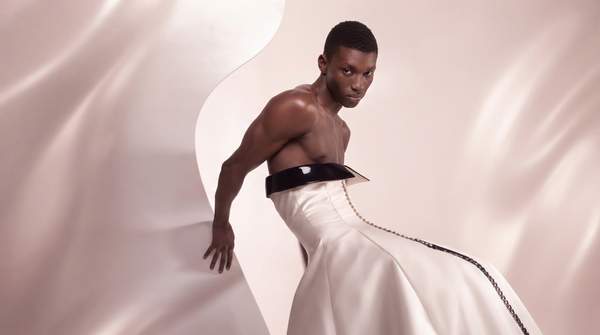
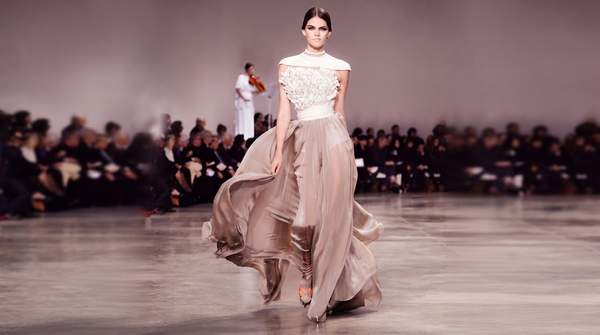
The second is the sculpted hip and skirt. Roseberry's Spring 2025 collection illustrates both directions at once: invisible padding shaped the hips of his dresses and support materials created stiff flares, while wire and boning built half dome-like structures paired with airy tulle skirts. Sterlacci admired precisely this "combination of structure and softness"—the airiness of tulle set against the engineered rigidity of a bustier. The dramatic effect depends on the contrast: soft fabric only reads as soft when something hard is holding the form.
Recognizing Couture's Engineered Beauty
When you observe haute couture garments, identify the presence and purpose of internal structural elements like boning, interlinings, and padding to appreciate the engineering behind their complex silhouettes. The measurable indicator is the ability to visually deconstruct a garment's shape and infer the internal structural techniques used to achieve its form.
Practice it on the next runway image you see. A defined bodice edge suggests boning encased beneath. A boucle blazer holding a razor-sharp line suggests a muslin underlining. A hip that flares beyond the body suggests invisible padding. Once you can make those inferences, you are no longer just looking at clothes—you are reading their hidden architecture.