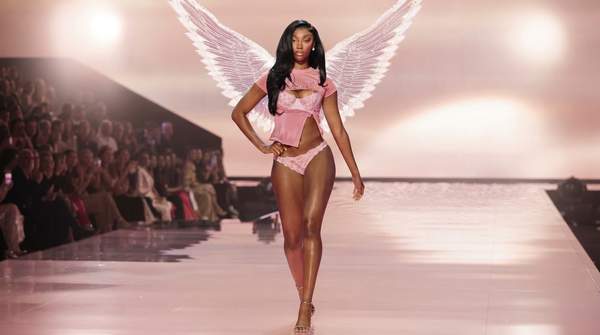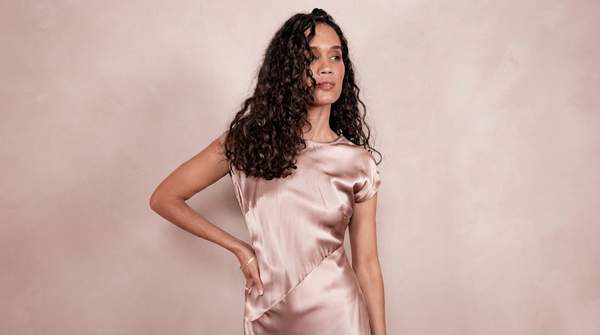
The bias cut is the reason some dresses seem poured onto the body rather than sewn onto it. Cut fabric at a 45-degree angle to its grain and it stops behaving like cloth and starts behaving like liquid — stretching, clinging and flowing in ways a straight-grain garment never can. It is, in my view, the single most consequential technical idea in twentieth-century fashion, and it is also one of the most expensive: industry analysis puts the total cost of goods for a bias-cut garment at 40 to 80 percent above a comparable straight-grain piece.
The Bias Cut: Unlocking Fabric's Fluidity
Every woven fabric is built from two sets of threads running at right angles to each other — the warp and the weft. Cut along either of those straight lines, the "grain," and the fabric has almost no give. Cut diagonally across them, at 45 degrees to the selvage, and everything changes: the diagonal path across the interlacing threads unlocks the fabric's inherent stretch, giving it an elasticity and drape that no straight cut can produce.
As one fashion essayist for The Georgia Review put it, garments cut on the straight or cross grains can feel "stiff, inelegant" — serviceable but utilitarian, covering a body without truly considering it. The bias, by contrast, demands "knowledge, skill, experience, and technique" from the designer, and rewards that effort with garments that "drape, move, and flow with the wearer."
The technique works best in lightweight, fluid fabrics — silk charmeuse, satin and crepe are the classics — because the diagonal cut amplifies whatever softness the cloth already possesses. The result is a silhouette that follows the body's contours rather than imposing a shape upon them.
Madeleine Vionnet: The Pioneer of Modern Drape
The bias cut was not invented in a vacuum, but it was Madeleine Vionnet who turned it into a design philosophy. According to the Victoria and Albert Museum, the French couturier — born in 1876, apprenticed to a lacemaker at twelve, and working as a dress-fitter in London by around 1897 — built her couture house's reputation in the early 1920s on "championing the bias-cut, a technique of cutting across the grain of a textile to produce a carefully draped silhouette which clung naturally to the body."
What matters here is that Vionnet's innovation was not merely cutting on the bias. She designed garments from the ground up to exploit the new properties the diagonal cut unlocked. Her chic, free-flowing dresses flattered the curves and forms of the female body so completely, the V&A notes, that they encouraged women to abandon cumbersome corsets altogether. That is a structural achievement, not just an aesthetic one: the fabric itself did the shaping work that whalebone and boning had done before.
Bias Cut vs. Straight-Grain: A Production Cost Comparison
So why doesn't everyone cut on the bias? The answer is arithmetic. Manufacturing analysis from Apex Fashion Lab quantifies the premium across every stage of production, and the cumulative effect explains why the technique remains a luxury marker rather than a default.
| Cost Factor | Straight-Grain | Bias-Cut | Premium |
|---|---|---|---|
| Fabric consumption | 1.0x baseline | 1.15–1.25x baseline | +15–25% |
| Cutting time | 1.0x | 1.5–2.0x | +50–100% |
| Sewing time | 1.0x | 1.5–2.5x | +50–150% |
| Pattern-making complexity | Standard | Advanced (requires settling time) | +30–50% |
| Sampling iterations | 2–3 rounds | 3–5 rounds | +50–100% |
| Total cost of goods | 1.0x | 1.4–1.8x | +40–80% |
Each line compounds the next. The diagonal cut wastes more fabric and demands precise pattern matching; the same elasticity that makes bias-cut cloth beautiful also makes it prone to stretching and distortion on the cutting table, slowing the cutter. Sewing requires delicate handling and specialized technique to prevent puckering, and because bias fabric "settles" — lengthening and shifting after cutting — patterns must be advanced-level and sampled more times before production. Contract manufacturers charge accordingly: bias-cut garments command CMT (cut, make, trim) charges of roughly $8 to $50 or more per piece, per the same analysis.
From 1930s Glamour to 1990s Minimalism: The Bias Cut's Evolution
Vionnet's dresses of the mid-1930s — several of which now sit in the V&A's collection — established the bias cut as the language of glamour: liquid satin, body-conscious drape, a silhouette that moved with its wearer. The technique never really left fashion after that; it simply changed registers with each era.
By the 1990s, the bias cut had become the signature of a different mood — the era of the supermodel and the minimalist slip dress, where the same diagonal drape that once meant Old World couture now meant sleek, understated modernity. The same physics, an entirely different poetry. That adaptability is, I think, the technique's real genius: the bias cut is not an aesthetic but a tool, capable of romance or restraint depending on the hand that wields it.
Contemporary Masters: John Galliano and Beyond
The clearest proof of Vionnet's long shadow is how explicitly her successors cite her. The Metropolitan Museum of Art holds a bias-cut evening dress from John Galliano's spring/summer 1994 "Princess Lucretia" collection — a romantic, historically inspired line referencing the Romanovs, Tolstoy's Anna Karenina, and, in the Met's own description, "Madeleine Vionnet's 1920s bias-cut, sylph-like dresses." Galliano's deconstructed bias-cut dresses are a reinterpretation, not a revival: sensual and dramatic where Vionnet was classical.
Today the technique spans the full price spectrum. Versace's silk bias-cut evening gowns retail in the $2,000–$15,000 range; Galliano's Maison Margiela pieces run $1,500–$8,000; and contemporary brands have made the bias-cut slip dress a high-street staple — Reformation sells silk versions at $148–$348, while labels like Realisation Par, Rat & Boa and Nanushka offer bias-cut skirts, dresses and vegan-silk pieces at accessible prices. The same cost structure that once confined the technique to couture now defines its value proposition at every tier.
Embracing the Bias: A Designer's Strategic Choice
Designers choose the bias cut for its unparalleled drape and fluidity, accepting its higher production costs and complexity as a strategic investment in garment aesthetic and luxury appeal. The 40 to 80 percent cost-of-goods premium is not an accident of inefficiency — it is the price of the very properties that make the technique worth using.
For readers, the measurable indicator is simple: watch for the continued presence of bias-cut garments in luxury collections and high-end ready-to-wear, signaled by product descriptions highlighting "bias cut" or "draped silhouette." As long as those words keep appearing — from couture runways to $148 slip dresses — the diagonal Vionnet drew a century ago is still doing its work.
Sources
- What Is Bias Cut? a Fabric Guide for Fashion Students — fabric fabric
- The Bias: Toward Fashion - The Georgia Review — The Georgia Review - Quarterly Since 1947
- Bias Cut: Madeleine Vionnet's Technique, Global Costs & Fabric Guide — Apexfashionlab
- Madeleine Vionnet – an introduction — Victoria and Albert Museum
- Evening dress — Metmuseum