The most memorable runway finales are never just the last walk of the night. Strip away the spectacle, and what remains are three repeatable ingredients: performance art, emotional narrative, and cultural reference. I've pulled together the strongest documented examples—from Alexander McQueen's robot-painted dress in 1999 to Coperni's spray-on moment in 2023—to show how each ingredient actually works, and how the finale, not the full show, is where a designer's story lands.
One caveat before we begin: this analysis rests on descriptions from fashion publications, not firsthand accounts or designer interviews, and it is deliberately not an exhaustive history of iconic finales. It is a lens for watching shows more intelligently.
Framework for Iconic Runway Finales
Here is the framework I use, built from the recurring themes across the coverage below. Each row pairs an element with a documented finale that exemplifies it, so you can see the technique and its effect side by side.
| Element | What it means | Example finale | Impact |
|---|---|---|---|
| Performance art | The finale becomes a live event, not a garment display | McQueen S/S 1999, "No. 13" | Described by Vogue as performance art; the moment defined both Harlow's and McQueen's careers |
| Emotional narrative | The closing walk carries a personal or commemorative story | Versace S/S 2018 | A 20th-anniversary tribute to Gianni Versace that, per British Vogue, "set the internet alight" |
| Cultural reference | The finale borrows from art, music or shared memory | Coperni S/S 2023 | A technology-driven moment that generated viral reach and measurable brand lift |
The point of the table is transferable: once you can name the element, you can ask whether a finale is doing artistic work or simply ending the show.
Performance Art: Alexander McQueen's "No. 13" (Spring/Summer 1999)
McQueen's finale for "No. 13" is the clearest case of a runway becoming performance. Shalom Harlow walked out in a white voluminous dress and stood on a rotating platform while two robotic arms—machines typically used to paint cars, as Vogue's review noted—sprayed black and yellow paint onto the fabric in what the review called "a carefully choreographed dance." When it ended, Harlow practically stumbled into the audience.
Two details elevate this beyond spectacle. First, the performance was unrehearsed, which means the tension between the model and the machines was real, not staged precision. Second, McQueen credited Rebecca Horn's 1991 installation "High Moon," in which two guns shoot red paint at each other, as the reference point—so the finale carried an explicit art-historical lineage rather than being pure theater for its own sake.
Vogue's verdict at the time was blunt: "It wasn't a fashion show. It was performance art." McQueen himself said No. 13 was "the only one that made [him] cry." Writing in AnOther Magazine, Susannah Frankel placed the show in its context—London's mid-to-late-90s moment when fashion shows were more akin to performance art than traditional presentations, comparable in cultural force to Britart's "Sensation"—and noted the show ran over 20 minutes, unprecedented by today's standards. The finale, in other words, was the thesis of an entire era.
Emotional Narrative and Cultural Reference: Versace's Supermodel Reunion (Spring/Summer 2018)
Where McQueen built his finale on technology and risk, Donatella Versace built hers on memory. To mark the 20th anniversary of her brother Gianni's death, she assembled the original '90s supermodels—Carla Bruni, Claudia Schiffer, Naomi Campbell, Cindy Crawford and Helena Christensen—for the closing walk. British Vogue, cataloguing the best finales of all time, described the tribute as one that "set the internet alight."
This is emotional narrative in its purest form. The clothes mattered less than the casting: five women who defined an era of fashion, walking together for a house whose founder had shaped them. The cultural reference was built in—the '90s supermodel is itself a shared cultural memory—and the emotional weight came from the occasion it commemorated. No robotics, no paint; just a reunion that converted grief and legacy into a single, photographable moment.
The lesson for the framework: narrative does not require spectacle. A finale can be iconic because of who walks it and why, and the brand identity it reinforces—Versace's place in supermodel history—was the entire payload.
Viral Moments and Brand Identity: Coperni's Spray-On Dress (Spring/Summer 2023)
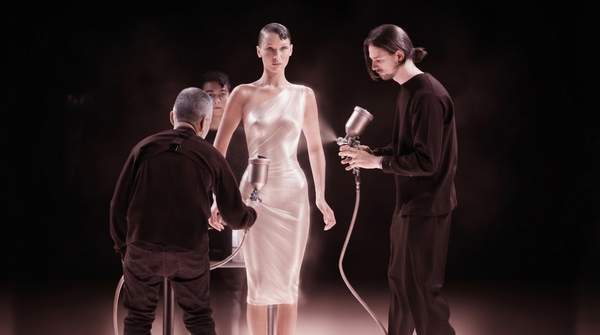
Coperni's 2023 finale shows the framework operating in the social-media era. The closing look was a dress sprayed directly onto Bella Hadid's body, a technology-driven spectacle that became an immediate viral moment. The measurable aftermath, as reported by Glam Observer: over one million views on TikTok under the #CoperniDress hashtag, a 3,000% increase in searches for the brand the day after the show, and an Instagram following that grew from 315,000 to 552,000.
Launchmetrics, the tech and data analytics provider, put the show's media impact value at $26.3 million. That number is the clearest evidence in this entire piece that a finale is now a commercial instrument, not only an artistic one.
What Coperni borrowed from McQueen is visible: the spray, the single model, the machine. What it added is the distribution layer—a finale engineered to travel as video, converting performance art into brand identity and search traffic within 24 hours.
Elevating a Finale to Icon Status
Designers aiming to create an iconic runway finale should integrate elements of performance art, emotional narrative, and cultural reference to maximize impact and lasting memory. The three cases here show the recipe is flexible: McQueen fused art reference with unrehearsed risk, Versace fused memory with casting, Coperni fused technology with shareability.
The measurable indicator of success is consistent across all three: the finale generates significant, sustained media coverage and discussion beyond the immediate fashion season, and is referenced in future fashion discourse as a benchmark for innovation or storytelling. McQueen's robots are still cited more than two decades later; Versace's reunion is a fixture of "best finales" lists; Coperni's spray-on dress carries a dollar figure. Watch any show's closing walk against that standard, and you'll know within minutes whether you've just seen clothes—or a cultural moment.