Inside Palermo’s Palatine Chapel, golden Byzantine mosaics meet an intricately carved ceiling shaped by Islamic artistic traditions. A Norman king commissioned the chapel in the 12th century, bringing together craftsmen whose work reflected the cultures that had shaped Sicily long before his reign.
This extraordinary interior captures the island’s history in miniature. The Lost Worlds of Sicily, an eight-day historian-led small-group journey in the Buried Italy series from Italian History with Joseph, follows those cultural connections across ancient cities, Greek temples, Roman villas, medieval castles, and the living traditions of Sicily.
Palermo Reveals the World of Sicily’s Norman Kings
Palermo is an ideal introduction to an island where rulers inherited buildings, traditions, and artistic influences from their predecessors. Phoenicians, Romans, Arabs, Normans, and later powers each contributed to the city that visitors encounter today.
The Norman Palace and Palatine Chapel reveal an especially remarkable period of cultural exchange. Commissioned by Roger II, the chapel combines Byzantine mosaics, Islamic-inspired decoration, and Western architectural elements, reflecting the artistic resources of one of medieval Europe’s most sophisticated kingdoms.
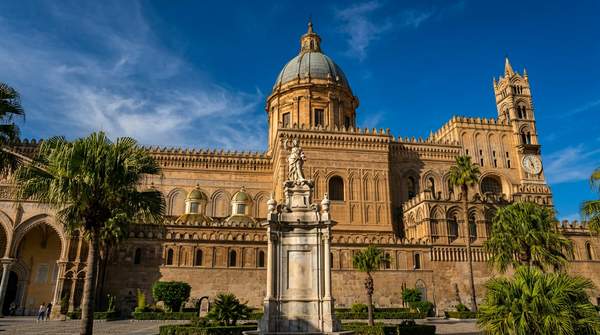
Nearby, Palermo Cathedral tells a different story through its changing architectural styles and royal tombs. Roger II and Frederick II are among the rulers buried here, connecting the grand buildings of Palermo to the political figures who shaped Sicily’s medieval history.
Buried Italy also includes a visit to a historic noble residence within Palermo’s ancient city walls. Its decorated interiors, ancestral portraits, and connections to centuries of Sicilian aristocratic life bring the island’s history into a setting that remains associated with a living family.
The experience offers a rare perspective on Palermo’s past. Royal chapels and cathedrals reveal how Sicily’s rulers expressed their authority, while the private residence preserves traces of the families who continued to inhabit that world.
Follow the Norman Kingdom Into Medieval Sicily
The journey continues beyond Palermo to Caccamo, where a great Norman castle stands above the surrounding valley. Its Sala della Congiura, or Conspiracy Hall, recalls the revolt against King William I in 1160, linking the fortress to the same royal dynasty encountered in Palermo.
At Cefalù, the cathedral commissioned by Roger II dominates the coastal town beneath a towering rocky headland. Its magnificent image of Christ Pantocrator reflects the Byzantine artistic influence that flourished under the Norman kings.
Monreale provides another extraordinary encounter with that tradition. Its cathedral contains an immense cycle of golden mosaics, while the adjoining cloister features intricately carved columns that display the skill and imagination of medieval craftsmen.
These visits reveal how Norman rulers used architecture to express political power, religious devotion, and cultural ambition. Moving between their castles and cathedrals allows travelers to follow the dynasty across the places where its influence survives.
Discover an Arab Bath and an Unfinished Greek Temple
Sicily’s Islamic heritage emerges in a different setting at Cefalà Diana. Here, a surviving medieval bathhouse preserves vaulted spaces and architectural features associated with the island’s centuries under Arab rule.
The journey then moves west to Segesta, where a monumental Doric temple stands against the hills of the Sicilian countryside. Its columns were never fluted, and the temple was never completed, leaving visible evidence of ancient construction practices.
Segesta was an important center of the Elymians, one of Sicily’s indigenous peoples. The temple and nearby theater reveal how Greek architectural traditions influenced communities beyond the Greek colonies themselves.
High above the western coast, Erice adds another historical connection. Its medieval Castello di Venere occupies a site associated with the worship of Venus and the earlier Phoenician goddess Astarte, illustrating how religious traditions could acquire new identities while retaining the same sacred ground.
From the Islamic-era bath to the Elymian temple and Erice’s ancient sanctuary, these sites introduce the many communities that contributed to Sicily’s cultural identity. Each offers a distinct encounter with a past that remains visible in the island’s architecture and landscape.
Cross the Lagoon to Phoenician Mozia
One of the most intriguing experiences on The Lost Worlds of Sicily takes place on Mozia, a small island in a shallow lagoon off the western coast. Buried Italy includes a boat crossing to this former Phoenician settlement, once connected to the maritime trading networks of the ancient Mediterranean.
Mozia’s archaeological remains preserve traces of a community whose history was shaped by commerce, cultural exchange, and conflict. Its island setting creates an immediate sense of the relationship between the Phoenicians and the sea routes that connected their settlements.
Inside the Whitaker Museum stands the celebrated Charioteer of Motya, an ancient Greek marble sculpture discovered on the island. The figure’s extraordinary craftsmanship and its discovery in a Phoenician setting make it a fascinating example of the artistic connections between Mediterranean civilizations.
The route also takes travelers through the Trapani salt pans, where shallow waters and traditional windmills mark a landscape associated with salt production for centuries. Together, the lagoon, archaeological island, and coastal landscape reveal the importance of western Sicily’s maritime world.
Explore Greek Temples and a Roman Villa Buried for Centuries
At Agrigento, the Valley of the Temples reveals the architectural ambition of ancient Akragas, one of the great Greek cities of Sicily. The monumental temples stand along a ridge overlooking the surrounding countryside, their surviving columns recalling the wealth and religious life of the ancient settlement.
The Temple of Concordia is particularly impressive. Among the best-preserved ancient Greek temples in the world, it allows visitors to appreciate the proportions and construction techniques of a building that has survived for more than two thousand years.
The journey then moves inland to Villa Romana del Casale near Piazza Armerina, where an expansive late Roman residence preserves an extraordinary collection of floor mosaics. Hunting scenes, mythological figures, animals, and athletic activities appear in intricate designs that once decorated the rooms of a wealthy household.
Among the best-known images are the young women depicted participating in athletic activities, often nicknamed the “bikini girls.” Other mosaics reveal elaborate hunting scenes, providing insight into the interests, social standing, and visual culture of the villa’s ancient occupants.
Agrigento and Villa Romana del Casale offer two different encounters with Sicily’s ancient world. Monumental temples express the ambitions of a Greek city, while the Roman villa preserves the artistry and domestic surroundings of a later civilization.
Find a Greek Temple Inside Siracusa’s Cathedral
In Ortigia, the historic center of Siracusa, one of Sicily’s most remarkable examples of architectural continuity stands in a busy cathedral square. The Cathedral of Siracusa incorporates the columns of a fifth-century BC Greek temple dedicated to Athena.
Those original Doric columns remain visible within the church, revealing how later generations adapted an ancient sanctuary for changing religious traditions. The building’s transformation across centuries makes the history of Greek, Christian, and Islamic Sicily tangible within a single structure.
Siracusa was once among the most powerful Greek cities in the Mediterranean, and the cathedral preserves a direct connection to that extraordinary past. The Buried Italy journey continues north to Taormina, where the ancient theater overlooks the Ionian Sea beneath the imposing presence of Mount Etna.
The theater’s Greek origins, Roman alterations, and dramatic coastal setting bring several dimensions of Sicilian history together. After traveling from Palermo’s Norman palaces through Phoenician and Greek archaeological sites, visitors reach a landscape where the ancient world remains part of one of Sicily’s most memorable views.
Taste Sicily’s History Through Its Living Traditions
Sicily’s food traditions offer another way to encounter the cultures that shaped the island. Centuries of Mediterranean exchange contributed to regional dishes, pastries, agricultural practices, and wines that continue to define Sicilian life.
In Palermo, Buried Italy includes a tasting of freshly filled cannoli at the historic convent bakery of Santa Caterina. Its revived pastry-making traditions connect a beloved Sicilian specialty with the convent communities that helped preserve local recipes.
The program also includes a welcome dinner and a farewell feast featuring regional cooking. Near Mount Etna, travelers taste wines produced in the volcano’s distinctive growing environment, where the landscape contributes another dimension to Sicily’s culinary identity.
These experiences create an enjoyable rhythm between the archaeological visits. Historical discoveries continue through food, wine, and the traditions of the communities that inhabit the island today.
Experience Sicily Through Buried Italy’s Historian-Led Journey
Designed by historian and author Joseph Walker, The Lost Worlds of Sicily brings the island’s major historical periods together in a carefully arranged small-group program. The eight-day itinerary includes seven nights of hotel accommodations with breakfast, private minibus transportation, specified archaeological admissions, the boat crossing to Mozia, airport transfers, and selected meals and tastings.
Historical commentary is provided by an Italian Cultural Expert trained by Walker, whose decades of experience in Italian history and cultural travel inform the Buried Italy series. The programs have an average group size of 10, creating opportunities for shared discovery and engagement with the places visited.
The journey begins in Palermo and continues across western and central Sicily before reaching Siracusa and Taormina, with departure from Catania. This connected route allows travelers to experience the island’s successive civilizations while the transportation, accommodations, and scheduled visits are organized within the program.
Chameleon Travel Shop, which Walker helps manage, operates the Buried Italy journeys. Travelers can examine the detailed Sicily itinerary and available departures through Italian History with Joseph or schedule an online consultation with Walker to discuss their interests before selecting a trip.
Frequently Asked Questions
Which historical periods does The Lost Worlds of Sicily cover?
The journey follows Sicily’s Greek, Phoenician, Roman, Arab, and Norman history through archaeological sites, historic towns, royal buildings, and cultural experiences. Its route connects ancient temples and Roman mosaics with medieval castles, cathedrals, and surviving architectural traditions.
Does the Buried Italy Sicily tour include Palermo and Agrigento?
Yes. The itinerary includes Palermo’s Norman Palace, Palatine Chapel, cathedral, and other historic places, along with Agrigento’s Valley of the Temples. It also visits Segesta, Mozia, Villa Romana del Casale, Ortigia, and Taormina.
Who provides historical commentary during the Sicily journey?
An Italian Cultural Expert trained by Joseph Walker provides historical commentary throughout the program. Walker designed the historian-led Buried Italy series, drawing on his background as a historian, author, and longtime specialist in Italian travel.
What does the eight-day Sicily program include?
The listed arrangements include seven nights of accommodations with breakfast, private transportation, specified archaeological admissions, the Mozia boat crossing, airport transfers, selected meals, a Palermo cannoli tasting, and an Etna wine tasting. Travelers can find the detailed inclusions and departure information on the individual journey page.
Experience Sicily’s Extraordinary Past With Buried Italy
From Palermo’s golden Norman chapels to the Greek temples of Agrigento and the ancient columns inside Siracusa’s cathedral, The Lost Worlds of Sicily brings centuries of history together in one remarkable journey. Discover Buried Italy’s Sicily history tour through Italian History with Joseph, review the available departures, and choose the historian-led experience that brings the island’s extraordinary civilizations to life.