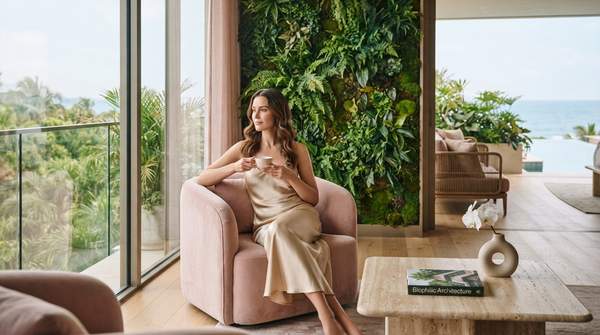
The most compelling luxury hotels today do not simply decorate with greenery; they are engineered around a documented framework of human responses to nature. The influential "14 Patterns of Biophilic Design," developed by Terrapin Bright Green, organizes those responses into three categories — Nature in the Space, Natural Analogues, and Nature of the Space — and hospitality research now links such design to psychological restoration, guest satisfaction, and a willingness to pay a premium for high-quality biophilic environments. Understanding the framework lets a traveler distinguish a genuinely restorative property from one with a decorative plant in the lobby.
Understanding Biophilic Design in Luxury Hospitality
Biophilic design addresses a simple disconnect: modern travelers spend their stays inside buildings, while their minds and bodies remain tuned to natural systems. The Terrapin Bright Green report, first published in 2014, frames biophilic design in the context of architectural history and the health sciences, and its patterns were not invented on a whim. The report states that its patterns were developed through extensive interdisciplinary research, drawing on the work of Christopher Alexander, Judith Heerwagen, Rachel and Stephen Kaplan, Stephen Kellert, and Roger Ulrich, with more than 500 publications on biophilic responses mined to extract patterns useful to designers of the built environment.
Crucially, the framework was written to address universal issues of human health and well-being — stress, visual acuity, hormone balance, creativity — rather than sector-specific space types. That generality is precisely what makes it portable into luxury hospitality: the patterns are meant to be flexible and adaptive, allowing project-appropriate implementation in interiors and exteriors alike. Applying them to a hotel is an act of translation, not invention.
Nature in the Space: Direct Connections to the Natural World
The first category covers the direct, measurable presence of nature in a space. Terrapin's patterns here include a visual connection with nature, non-visual connections such as sound and scent, non-rhythmic sensory stimuli, thermal and airflow variability, the presence of water, dynamic and diffuse light, and a connection with natural systems — the awareness of natural processes like seasonal change.
In a luxury hotel, this category is the most visible and the most variable in quality. Hospitality design writing describes corridors designed to mimic natural pathways, with preserved plant installations creating the feeling of a journey through nature, and guest rooms reimagined as urban oases with preserved moss art serving as living headboards. A courtyard pool, a window framing real vegetation, or the sound of moving water in a spa all belong here. The test of authenticity is whether these elements are real, sensory, and maintained — not whether a photograph of a forest hangs in the elevator.
Natural Analogues: Indirect Representations of Nature
The second category, as the pattern list shows, shifts from direct nature to its indirect representation: biomorphic forms and patterns, material connection with nature, and complexity and order. Where Nature in the Space gives you a plant, Natural Analogues gives you the shape, texture, and grammar of nature rendered in designed materials.
This is the category where luxury hotels often excel quietly. Nature-inspired textures and materials creating a cocoon-like atmosphere, as described in hospitality design coverage, are Natural Analogues at work: a stone bathtub whose surface recalls river rock, timber joinery, a wallcovering whose pattern echoes branching, or a lobby whose geometry follows organic rather than strictly rectilinear lines. The distinction matters for evaluation. A hotel rich in analogues but poor in direct nature can feel warm and calming, yet it delivers a narrower slice of the framework's intended effect — the material aspect of nature without its living presence.
Nature of the Space: Experiential Connections to Natural Systems
The third category is the least discussed and arguably the most sophisticated. As one design commentary explains, the first two categories focus on the material aspect of nature, while Nature of the Space patterns cover the experience of nature, highlighting the feelings that characterize a restorative space. Terrapin's patterns here are prospect, refuge, mystery, and risk/peril.
Prospect means uninterrupted views over a distance, creating feelings of calm and safety; people are drawn to environments that recall the open savannahs where humans evolved as a species. In a hotel, prospect is the suite whose windows sweep across a valley or city skyline, while refuge is the deeply upholstered reading nook beside it. Mystery is the corridor that curves so you cannot see its end, inviting exploration; risk/peril is the infinity edge that quickens the pulse. A great luxury property choreographs all of these — the arrival sequence that reveals the space in stages, the alternation of open and sheltered areas — so that the guest's movement through the hotel itself becomes a restorative experience.
Enhancing Guest Well-being Through Biophilic Design
The well-being case rests on academic research rather than marketing copy. A hospitality research review notes that biophilic designs — embedding natural elements like greenery and natural light in physical environments or service encounters — have been recognized as a potential means of alleviating adverse effects and supporting individuals' psychological restoration and well-being, citing studies including Song et al. (2022), Suess et al. (2024), and Totaforti (2018). Industry commentary echoes the pattern: biophilic design has been shown to have benefits including improved mental health, increased productivity, and enhanced creativity, and in hotels it aims to make guests feel more connected to nature while keeping them relaxed and comfortable.
For the guest, the practical translation is concrete. Hospitality design writing links nature-inspired room environments to better sleep quality and overall well-being, addressing what it calls the very essence of hospitality — rest and rejuvenation. The Terrapin framework's own scope — stress, visual acuity, hormone balance, creativity — signals that these are not merely aesthetic claims but responses the built environment can measurably provoke.
Biophilic Design as a Driver of Perceived Value and Brand Differentiation
The business case runs through a specific concept: perceived value. Hospitality research, drawing on Baker and Fulford (2016), describes perceived value as a holistic evaluation of utility that emerges from comparing the benefits gained with the costs incurred for a product or service — and notes that customers rarely evaluate utility and costs in absolute terms; their decisions are guided by subjective perceptions of value. In the hospitality industry, customers primarily evaluate their experiences based on the overall value they derive from the products and services they consume.
Biophilic design shifts that subjective calculus. The research review observes that hotel biophilic design has recently garnered the attention of hospitality scholars due to its potential impact on desirable marketing outcomes such as guest satisfaction, stress relief, and behavioral intentions, citing Han et al. (2020), S. H. Lee (2019), and Nanu et al. (2020). Its conclusion is direct: nature-inspired hospitality spaces can command premium pricing and enhance perceived value for guests, allowing hotels to strategically position these designs in their branding and pricing strategies, particularly to attract wellness seekers and eco-conscious tourists.
Two caveats keep this honest. The same research underscores the challenges of maintaining high-quality biophilic design and the need to critically evaluate whether its benefits justify the considerable costs and operational difficulties of implementation. And the premium guests will pay is attached to quality — the research recommends authentic, well-integrated, and carefully maintained natural features providing both functional and sensory value. A neglected living wall can subtract value rather than add it.
Evaluating Biophilic Design in Luxury Hotels: A Decision Framework
To use this framework as a traveler or a designer, take the specific design elements of a property and sort them into the three categories. The analytical operation is categorization: each element — a living wall, a stone texture, a sweeping view — belongs to one category, and the distribution across categories reveals whether the hotel offers a deeply integrated biophilic experience or simple decorative greening.
| Category | What it covers | Luxury hotel examples | What to check for authenticity |
|---|---|---|---|
| Nature in the Space | Direct presence of nature: visual and non-visual connection, water, dynamic light, natural systems | Living walls; preserved plant installations in corridors mimicking natural pathways; moss-art headboards; water features | Are the elements real, sensory, and well maintained, or artificial and neglected? |
| Natural Analogues | Indirect representation: biomorphic forms and patterns, natural materials, complexity and order | Nature-inspired textures and materials creating a cocoon-like atmosphere; organic forms in furniture and finishes | Do materials and patterns genuinely evoke natural form, or merely carry a "natural" label? |
| Nature of the Space | Spatial experience: prospect, refuge, mystery, risk/peril | Uninterrupted views over a distance; sheltered retreats within larger rooms; arrival sequences that reveal space in stages | Does the layout itself create calm, safety, and exploration, independent of decoration? |
The evidence-derived result of this exercise is a judgment about depth. A hotel scoring only in Nature in the Space — a lobby wall of greenery and nothing else — offers decorative greening. A hotel scoring across all three categories, with maintained living elements, natural materials and forms, and a spatial layout built around prospect and refuge, offers the integrated experience that the research associates with restoration and premium willingness to pay. For professionals planning a property, the same matrix works in reverse: it exposes which category is missing from a design strategy before capital is committed.
Making Informed Choices: Recognizing Authentic Biophilic Luxury
Travelers and hospitality professionals should prioritize hotels that demonstrate a deep, multi-faceted integration of biophilic design principles across all three categories to maximize well-being benefits and perceived value. The measurable indicators to watch are the ones the research itself connects to biophilic quality: increased guest satisfaction scores, higher average room rates, and positive guest reviews specifically mentioning the natural elements and their impact on relaxation and experience. A property whose guests consistently name the moss headboard, the garden corridor, or the view from the bed is delivering the framework as intended — and, according to the hospitality research on perceived value, capturing the premium that follows.
Sources
- 14 Patterns of Biophilic Design — Terrapinbrightgreen
- MDPI
- Reimagining Hospitality Through Nature’s Lens: Biophilic Design for Hotels & Restaurants — Gardenonthewall
- Biophilic design: nature of the space — anooi
- AMBIUS