The most important finding in recent research on augmented reality try-ons in luxury retail is counterintuitive: the technology works not because it looks flawless, but because it makes customers feel capable, comfortable and in control. A study by Megha Bharti and Anjuman Antil, published in the Journal of Retailing and Consumer Services, found that perceived realism "does not significantly contribute to the online luxury customer experience," challenging what the authors describe as the dominant view that AR's effectiveness hinges on ultra-realistic representations. Instead, three experiential qualities—cognitive ease, virtual intimacy and perceived consumer empowerment—emerged as the primary drivers.
That finding reframes the strategic question for luxury brands. The real risks in AR try-on are not technical fidelity but data bias, privacy governance, scaling costs and the dilution of brand authenticity—issues that sit outside the rendering pipeline but determine whether the investment strengthens or damages a maison's equity.
Beyond Realism: What Drives Luxury AR Try-On Success?
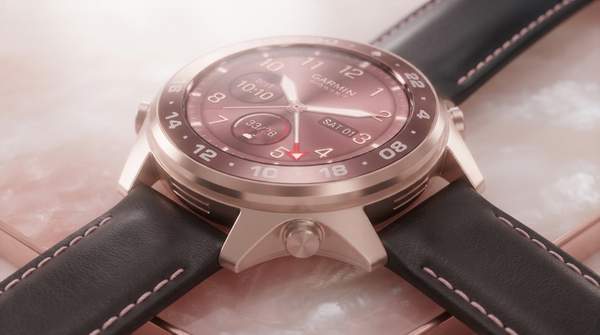
Across two studies reported in their abstract, Bharti and Antil found that AR-based virtual try-ons enhance the luxury customer experience through cognitive and affectual components, with effects significantly stronger for low-tactile products than high-tactile ones. That distinction matters for planning: goods whose appeal rests on appearance and fit—watches, eyewear, jewellery-adjacent accessories—benefit more than items whose value depends on how they feel in the hand or on the skin, such as fine leather or certain fabrics.
The most striking element of the finding is what it rules out. Brands routinely pour budget into photorealistic rendering on the assumption that a customer who cannot touch the product must at least see it perfectly. The research suggests this is the wrong priority. A try-on that renders convincingly but leaves the customer confused, passive or self-conscious will underperform one that is merely adequate visually but effortless and confidence-building to use.
This is not a license for poor visuals. It is a statement of relative weight. Once realism passes a functional threshold—the item sits plausibly on the customer's body or face—additional graphical polish contributes less to the experience than how easily the customer navigates the tool and how empowered they feel by it.
The Core Pillars of a Positive AR Experience
The first pillar, cognitive ease, is the frictionlessness of the experience: how quickly a customer understands what to do, sees the result and moves toward a decision. A try-on that demands awkward camera positioning, repeated calibration or app downloads introduces friction that luxury customers, whose expectations are calibrated by white-glove service, will not forgive.
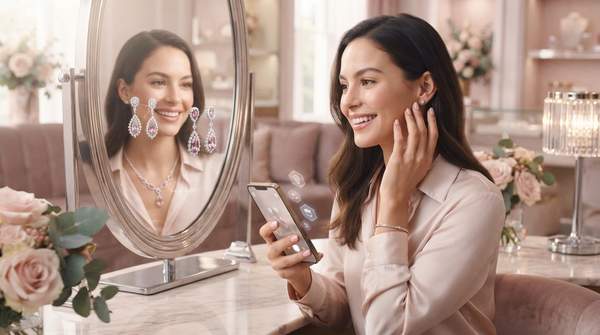
Virtual intimacy is subtler. It describes the closeness a customer feels when a product appears on their own body or face—a private preview previously available only in a boutique fitting room. Done well, this recreates something of the intimacy of personal service in a digital channel, which is precisely the quality luxury retail has struggled to transplant online.
Perceived consumer empowerment is the third and arguably most decisive. Seeing an item on yourself, at your convenience, with the freedom to compare and decide privately, shifts control from the sales associate to the customer. For a segment that values autonomy and discretion, that shift is itself a luxury good. Notably, the research abstract indicates these drivers matter most where touch is absent—which is exactly the gap a digital try-on is trying to bridge.
Key Implementation Challenges for Luxury Brands
The obstacles between a promising pilot and a scaled deployment are organizational as much as technical. Reporting on how virtual try-ons are reshaping fashion retail, Rajashree Goswami writes in CTO Magazine that real-time fabric simulation and AR rendering strain cloud architecture, and that without optimization costs rise quickly at scale. For a brand used to controlling unit economics tightly, compute spend that grows with every try-on session is a genuine budget question, not a footnote.
Privacy is equally consequential. Virtual try-on systems rely on body imagery—a sensitive data category that, as Goswami notes, requires transparent storage, consent and governance. A luxury customer allowing a brand's camera to capture their face, hands or body is extending an unusually high degree of trust; mishandled, that data becomes a reputational liability far out of proportion to any convenience gained.
Integration is the quieter hurdle. Goswami observes that try-on tools must connect with inventory intelligence, CRM systems, personalization engines and omnichannel analytics—her summary is blunt: "Isolated deployments create friction; integrated deployments create value." A try-on that cannot reflect actual stock, sizes or a customer's history delivers a hollow imitation of luxury service.
Addressing Data Bias and Authenticity in AR
Two risks deserve special attention because they strike directly at what luxury brands sell: exclusivity built on personalization, and a reputation for authenticity. If the underlying models underrepresent certain body types or skin tones, Goswami writes, the experience becomes exclusionary—and robust fairness testing is essential. A try-on that renders beautifully for some customers and inaccurately for others does not merely underperform; it actively alienates the very people a luxury brand courts, undermining its positioning on personalization.
Authenticity cuts both ways. Goswami argues that virtual try-on succeeds when it reflects real body diversity, avoids beautification distortion and embraces authenticity rather than perfection, warning that retailers who over-stylize or alter body proportions "risk losing credibility with a generation attuned to digital honesty." For luxury, whose value rests on the integrity of the product and the experience around it, an inaccurate or flattering representation does not flatter—it dilutes brand value and the customer's trust in what she is seeing.
Industry commentary in the same space acknowledges the more basic trade-off: as wanna.fashion, a provider of virtual try-on technology for the luxury industry, puts it, the technology can improve the customer experience and boost sales, but implementation costs and the inability to replicate the in-person experience remain real constraints.
AR Virtual Try-On Decision Framework for Luxury Brands
The matrix below connects the research-backed success drivers to the risks each one must be weighed against, giving brand teams a checklist that goes beyond technical feasibility. Read each row as: this is what drives the experience—here is the question you must answer before committing.
| Aspect | Finding | Key question and implication for luxury brands |
|---|---|---|
| Primary success factors | Cognitive ease, virtual intimacy and perceived consumer empowerment drive the enriched luxury AR experience; effects are strongest for low-tactile products. | Is our AR roadmap organized around ease, intimacy and empowerment—or around graphics? Prioritize low-tactile categories first. |
| Role of realism | Perceived realism does not significantly contribute to the online luxury experience, per Bharti and Antil's abstract. | "Good enough" realism paired with strong experiential design beats a perfection-first development path. |
| Privacy and consent | Body imagery is sensitive data requiring transparent storage, consent and governance. | Can we document exactly how try-on images are stored, used and deleted? Without this, the tool is a liability. |
| Infrastructure and cost | Real-time simulation and rendering strain cloud architecture; costs rise quickly at scale without optimization. | Have we modeled per-session compute costs at projected volume, not just pilot scale? |
| Data bias and inclusivity | Models trained on limited datasets misrepresent diverse body types and skin tones, making the experience exclusionary. | Have we run fairness testing across our actual customer base before launch, not after complaints? |
| Brand authenticity | Over-stylization and altered proportions erode credibility; inaccurate representation dilutes brand value. | Does the try-on show the product and the customer truthfully? Audit for beautification distortion. |
One caveat belongs here honestly: the framework rests on a study abstract and industry commentary, not on primary research into specific brand implementations, so it should guide strategy rather than substitute for a brand's own pilot data.
Strategic Imperatives for Luxury AR Try-On Success
The decision for luxury brands is clear: prioritize AR virtual try-on solutions that enhance cognitive ease, foster virtual intimacy, and empower consumers, rather than solely focusing on photorealistic rendering. Concurrently, invest in robust data governance and inclusive design to mitigate implementation risks like data bias and preserve brand authenticity.
The measurable indicator of success: strong implementations will show increased customer engagement metrics, positive feedback on ease of use and personalization, and a demonstrable reduction in returns attributed to fit or expectation mismatch, alongside a diverse and inclusive user base. If those four signals move together, the strategy is working; if engagement rises while inclusivity metrics narrow, the tool is succeeding with the wrong customers and quietly failing with the rest.