Luxury adventure travel is no longer about marble lobbies and champagne on demand. The modern definition combines two things that used to live apart: deeply personal, private experiences on one side, and verifiable environmental and community impact on the other. Travel writing from Stay Adventurous captures the first half—depth over display, flexibility, one-on-one guiding, and privacy as the ultimate accommodation luxury. Writing by Alejandro Teus for Impactful Travel captures the second—eco-friendly elegance, conservation, and community-based tourism. I want to show you how to hold both at once.
Introduction: Redefining Luxury Adventure for the Modern Explorer
Here is my honest read: the discerning explorer today should judge a trip by what it gives back and how personally it is shaped, not by its star count. As Impactful Travel's Alejandro Teus traces it, luxury travel has undergone a remarkable transformation, shifting from pure opulence toward a more meaningful and responsible experience—away from the private yachts and palatial hotels that once defined the category. Stay Adventurous frames the same shift from the traveler's side: luxury vacations increasingly focus on depth rather than display. Two very different publications, one conclusion. That convergence is the whole story.
The Evolution of Luxury Travel: Beyond Opulence
Historically, as Teus recounts, luxury travel was reserved for royalty and the elite—grand voyages, lavish train journeys, palatial stays—before the twentieth century brought five-star resorts, private jets, and exclusive destinations for an affluent clientele. What replaced that model is quieter and slower. Stay Adventurous describes itineraries that linger in one region rather than hopping between hotspots, hands-on activities rather than spectacles watched from a distance, and even accommodation that rejects all things digital. Flexibility, too, is treated as a modern luxury: journeys taken at your own pace. This is a significant transformation from historical luxury concepts, and it indicates a move toward more intentional, purpose-driven choices.
Pillar 1: Exclusivity and Personalization in Adventure
The first pillar is personal. Stay Adventurous identifies exclusivity's practical ingredients: one-on-one guiding that lets travelers pursue their own interests rather than a group's schedule, private aviation that connects remote regions in larger countries like Argentina or South Africa without lengthy layovers, and accommodation where privacy is everything—a villa with dedicated butler service and a chef cooking from guest-devised menus. Note what exclusivity means here: not being seen by others, but being shaped around you. These elements cater to individual preferences and enhance the personal experience. A trip fails this pillar the moment your itinerary is built for a crowd.
Pillar 2: Environmental Responsibility and Conservation
The second pillar is planetary. Impactful Travel defines sustainable luxury travel as blending comfort and exclusivity with responsible practices, and Teus makes those practices concrete: eco-friendly accommodations, minimizing environmental footprint, and conservation as a priority—imagining, for instance, participation in a wildlife conservation project that directly benefits endangered species. The elegance and the ethics are not in tension in this framing; a rainforest lodge designed to blend harmoniously with nature is presented as luxurious because of its lightness, not despite it. This is a fundamental component of responsible and sustainable luxury experiences. In my view, an operator with no stated environmental practice is offering the old luxury, not the new.
Pillar 3: Community and Cultural Engagement
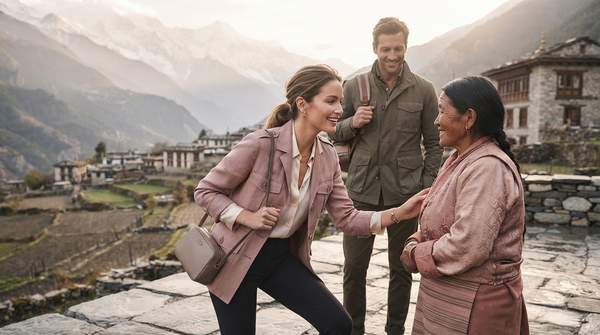
The third pillar is human. The Impactful Travel feature emphasizes authentic cultural exchanges, community-based tourism, supporting local economies, and culinary sustainability—a private dinner crafted from organic, locally sourced ingredients sits comfortably in this vision alongside world-class service. Teus also assigns travelers an active role: choosing responsible operators, offsetting flight emissions, engaging with local communities, and prioritizing ethical spending. Travelers can drive change, in other words; the demand side builds the market. Done well, this ensures meaningful interaction and positive impact on host communities—luxury that leaves a place better than the brochure found it.
A Framework for Evaluating Modern Luxury Adventure Travel
Neither source alone gives you the complete modern definition, which is why I synthesized their criteria into one decision matrix. Score any proposed trip against all three pillars; strong exclusivity cannot compensate for absent impact, and vice versa.
| Pillar | What to look for | What it tells you |
|---|---|---|
| Exclusivity & personalization | One-on-one guiding, private transport, flexible pacing, private accommodation such as villa stays with dedicated service | The experience is shaped to you, not to a group schedule |
| Environmental responsibility | Eco-friendly accommodation, minimized footprint, explicit conservation participation | The trip's comfort does not come at the environment's expense |
| Community & cultural engagement | Community-based tourism, authentic cultural exchange, local sourcing, ethical spending | Host communities benefit economically and meaningfully |
Use it as a classification tool: a trip strong on all three rows matches the modern definition; strong on one is old luxury in new packaging. The matrix merges the privacy-focused and impact-focused schools of thought into a single assessment, which neither individual source attempted.
Making Informed Choices: Redefining Your Adventure
Travelers should evaluate luxury adventure experiences by considering both personal exclusivity and verifiable positive environmental and community impact. As Teus concludes, this kind of travel is about meaningful transformation—experiences that resonate far beyond the journey itself. Before you commit to anything, apply the test: look for a travel itinerary or operator's program description that explicitly details commitments to privacy and bespoke services alongside specific sustainability or community engagement initiatives. If those commitments are named and concrete, you are looking at contemporary luxury. If they are vague or absent, you are paying for the twentieth-century version.
Sources
- Redefining Luxury Travel with Exclusive Experiences — Stay Adventurous | Mindset for Travel Blog
- The New Face of Luxury: Discovering Sustainable Travel with Impact — Impactful Travel