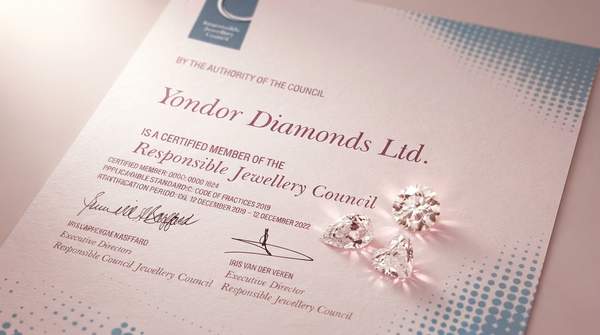
Here is the uncomfortable truth I wish every jewelry counter acknowledged: the three best-known ethical certifications in luxury jewelry are not interchangeable, and none of them covers everything. The Kimberley Process exists to stop diamonds funding rebel militias—and nothing more. Fairmined is about fair wages and sustainable practices for artisanal miners of gold and precious metals. The Responsible Jewellery Council (RJC) casts the widest net, with ethical, social, human rights, and environmental standards running from mine to retail. If you have been treating these labels as a single seal of virtue, you have been sold a simplification.
Understanding Ethical Sourcing in Luxury Jewelry
Ethical sourcing has moved from marketing garnish to genuine purchase criterion, and certifications are how the industry answers the question. Writing for AMAYRA, a luxury jewelry brand, the author notes that standards including Fairmined, the RJC, and the Kimberley Process "provide assurance to consumers that gemstones and precious metals meet rigorous ethical criteria." But that sentence conceals as much as it reveals. Each standard was built to solve a different problem, at a different point in the supply chain, with a different theory of responsibility. Understanding which promise you are actually buying is the first act of discernment.
The same source is candid that verified ethical sourcing "often involves higher costs, more complex logistics, and the need for robust supplier relationships." That friction is precisely why certifications matter: they are the industry's attempt to make an opaque chain legible. Whether they succeed depends on what each one claims to do.
The Kimberley Process: Focusing on Conflict Diamonds
The Kimberley Process Certification Scheme is the oldest and narrowest of the three. Established by the UN General Assembly in 2003, it allows governments to certify diamonds as conflict-free, provided they adhere to guidelines including transparent business practices, exchanging statistical evidence, and trading only with other compliant members. As of the writing of the GIA's Gems & Gemology article by Jennifer-Lynn Archuleta, 52 countries voluntarily met its minimum requirements.
But read the fine print, because it matters. The Kimberley Process extends only to rough diamonds used to fund rebel militia efforts to overthrow a legitimate government—not to other human rights issues. A jeweler's guide from Bel Viaggio Designs makes the same point plainly: the scheme "addresses conflict-free diamonds but has a narrower scope that does not cover broader human rights or environmental protections." A Kimberley certificate tells you nothing about wages, working conditions, or environmental damage. It was never designed to.
Fairmined Certification: Empowering Artisanal Miners
Fairmined occupies a different niche entirely: the small-scale miner. Where the Kimberley Process is governmental and diamond-specific, Fairmined focuses on fair wages and sustainable mining practices for gold and associated precious metals, aiming to ensure these materials are sourced responsibly in ways that benefit artisanal and small-scale mining communities. Both the AMAYRA article and the Bel Viaggio Designs guide describe it as a renowned industry standard that promotes responsible practices within mining communities.
I find this the most emotionally legible of the three certifications, because its beneficiary is concrete: the person at the rock face, not an abstraction like "supply chain integrity." Its limitation is the mirror of its strength. Fairmined speaks to a specific material stream—gold and precious metals from small-scale operations—and says nothing about diamonds or colored gemstones. If your concern is a ruby's origin, Fairmined is not the certificate that answers it.
Responsible Jewellery Council (RJC): Comprehensive Standards
The RJC, a not-for-profit standard-setting organization founded in 2005, takes the broadest approach. Its own Code of Practices documentation describes a common standard for ethical, social, human rights, and environmental practices, defining requirements for responsible business throughout the jewelry supply chain, from mine to retail. The Code comprises 45 provisions designed to fulfill six objectives, including improving legal and regulatory compliance, strengthening public reporting, and increasing supply chain due diligence to uphold human rights, support community development, promote anti-corruption efforts, and manage sourcing risks.
That is a genuinely comprehensive architecture—ethics, labor, and environment in one framework, per the Bel Viaggio guide's characterization. The RJC's standards were last revised in 2024, with the next revision due in 2029. One honest caveat from me: this article compares stated scope and purpose, not auditing or enforcement effectiveness. A wide standard on paper and a well-audited one are different questions, and I am not in a position to judge the second.
Ethical Sourcing Certifications: A Comparative Overview
Here is the side-by-side view I wish existed when I first tried to decode these labels. The comparison works by asking each standard the same three questions: what is it for, what does it actually cover, and where does it stop?
| Certification | Primary Focus | Scope of Issues Covered | Known Limitations |
|---|---|---|---|
| Kimberley Process (KP) | Preventing trade in conflict diamonds | Requires participating countries to meet minimum requirements preventing diamonds from financing rebel groups and militias; established by the UN General Assembly in 2003; 52 countries voluntarily met requirements as of the source's writing | Extends only to rough diamonds funding rebel militia efforts against legitimate governments—not to other human rights issues, wages, or environmental protections |
| Fairmined | Fair wages and sustainable mining practices | Ensures gold and associated precious metals are sourced responsibly, benefiting artisanal and small-scale miners and promoting responsible practices within mining communities | Applies to gold and precious metals from small-scale mining; does not address diamonds or colored gemstones |
| Responsible Jewellery Council (RJC) | Comprehensive ethical, social, human rights, and environmental standards | Code of Practices defines requirements from mine to retail via 45 provisions serving six objectives, including due diligence, human rights, community development, anti-corruption, and sourcing risk management; standards last revised 2024, next revision due 2029 | Stated scope is broad, but this article does not evaluate auditing or enforcement effectiveness; coverage depends on member adoption |
The pattern that emerges is a ladder of ambition: conflict narrowly defined at the bottom, miner welfare in the middle, and a full-spectrum standard at the top. None of the three subsumes the others.
Navigating the Complexities: Broader Challenges in Ethical Sourcing
Even the best certificate collides with a stubborn structural problem: traceability. The Bel Viaggio Designs guide cites a figure that stopped me short—only 11% of diamonds are fully traceable. That means the overwhelming majority of diamonds on the market cannot be followed from mine to showcase, which is why the same guide recommends requesting supply chain documentation and third-party verification from your jeweler, and why it suggests lab-grown stones offer a transparency advantage.
The GIA's Archuleta adds a sobering note for anyone buying colored stones: there are currently no binding international regulations on colored stone trade, even in a limited scope. Some governments have taken steps, but the colored gemstone buyer is navigating with far fewer guardrails than the diamond buyer. Her article also frames the upside: producers who disclose their ethical and sustainable practices create "a chain of responsibility that benefits miners, cutters, and other industry laborers," building consumer trust and demand. Transparency, in other words, is not just moral hygiene—it is commercially rational.
Informed Purchasing: Beyond the Certificate
When purchasing luxury gemstones, you should differentiate between certifications based on their specific scope and understand that no single certification guarantees complete ethical sourcing across all dimensions. The Kimberley Process answers one question about conflict; Fairmined answers questions about miners' wages and practices; the RJC attempts the whole chain. A certificate is the beginning of a conversation, not the end of one.
The measurable test is simple: before you buy, ask your jeweler specific questions about the certification's coverage—"Does this certification cover environmental impact or just conflict-free status?"—and about the traceability of the specific stone in front of you. If the answers are vague where the scopes above are precise, you have learned something valuable about the purchase, whatever you decide.