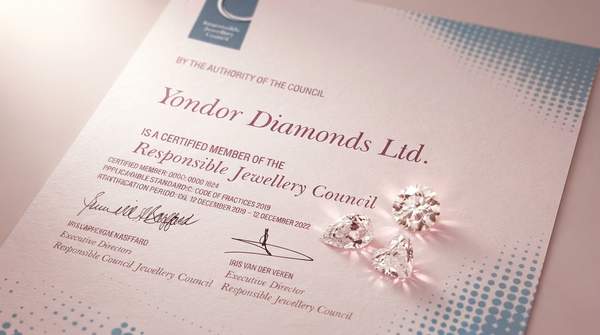
For consumers navigating the world of luxury jewelry, claims of "ethical sourcing" can be both reassuring and confusing. Two of the most frequently cited standards are the Responsible Jewellery Council (RJC) certification and the Kimberley Process Certification Scheme (KPCS). While both aim to address serious issues within the supply chain, they have fundamentally different goals, scopes, and functions. Understanding the distinction is crucial for making an informed purchase. The RJC provides a broad framework for responsible business practices across many materials, whereas the Kimberley Process has a singular, narrow focus on preventing the trade of conflict diamonds.
The Ethical Labyrinth of Luxury Jewelry
The journey of a gemstone or precious metal from a mine to a velvet-lined display case is often long, complex, and opaque, presenting significant ethical challenges. One of the most widely publicized issues is the trade in "conflict diamonds," also known as "blood diamonds." These are rough diamonds used by rebel movements or their allies to finance violent conflicts aimed at undermining legitimate governments. The direct link between the sale of these stones and widespread human rights violations spurred international action to disrupt this illicit trade. Beyond the financing of war, the jewelry industry faces deep-seated concerns regarding human rights and labor practices.
In many parts of the world, particularly in smaller-scale or artisanal mining operations, workers may face unsafe conditions, unfair wages, and other abuses. The environmental toll of mining is another critical consideration. The extraction of precious metals and gems can lead to significant soil degradation, water pollution, and the destruction of natural habitats if not managed with sustainable practices. These multifaceted problems have given rise to certification programs designed to provide assurance to both businesses and consumers. These initiatives aim to increase transparency and hold companies accountable for their sourcing methods in an industry where the origin of materials can be notoriously difficult to trace.
The Responsible Jewellery Council (RJC): A Broad Business Mandate
The Responsible Jewellery Council (RJC) is an international organization that establishes comprehensive standards for responsible business practices throughout the jewelry supply chain. Its certification is not applied to a single gemstone or piece of jewelry but to the companies themselves, encompassing the entire pipeline from mining operations to retail brands. The RJC's scope is intentionally broad, addressing a wide array of social, ethical, and environmental issues. According to the council's framework, certified members must adhere to strict guidelines covering human rights, labor rights, environmental impact, and ethical sourcing of materials.
This means a certified jewelry manufacturer has been audited to ensure it operates with transparency and that its processes respect both workers and the planet. A key feature of the RJC is its wide material scope, which applies to gold, silver, platinum group metals, diamonds, and colored gemstones. For a consumer, an RJC certification serves as a mark of trust in the brand itself. It guarantees that the company has committed to and been independently audited against global ethical standards. This certification signals a holistic approach to sustainability, providing assurance that the business behind the jewelry is dedicated to responsible practices across its entire operation.
The Kimberley Process (KPCS): A Focused Mission on Conflict
Established through a United Nations General Assembly resolution in 2003, the Kimberley Process Certification Scheme (KPCS) is a global initiative with a very specific and targeted objective: to eliminate the trade in conflict diamonds. It is a joint effort involving governments, the diamond industry, and civil society designed to stop diamond sales from financing violent rebel movements. As of 2016, 52 countries were voluntarily participating in the scheme. The KPCS functions by certifying shipments of rough diamonds as "conflict-free." Participating nations agree to trade rough diamonds only with other member countries and are required to implement internal controls to prevent conflict diamonds from entering the legitimate supply chain.
A KPCS certificate must accompany any export of rough diamonds, attesting that the shipment has been handled according to the scheme's rules. However, the scope of the Kimberley Process is deliberately and critically narrow. It defines conflict diamonds specifically as those used by rebel militias to overthrow a legitimate government. As a result, the certification does not address other serious human rights abuses, environmental damage, or poor labor practices associated with diamond mining. Furthermore, the KPCS applies only to rough diamonds, offering no oversight for colored gemstones or precious metals.
RJC vs. Kimberley Process: A Quick Comparison
To clarify their distinct roles, this table compares the core features of the Responsible Jewellery Council (RJC) and the Kimberley Process Certification Scheme (KPCS).
| Feature | Responsible Jewellery Council (RJC) | Kimberley Process Certification Scheme (KPCS) |
|---|---|---|
| Primary Goal | To provide a comprehensive framework for ethical, social, and environmental practices across the entire jewelry supply chain. | To prevent the trade of 'conflict diamonds' used to finance rebel movements against legitimate governments. |
| Scope of Issues | Covers human rights, labor rights, environmental impact, ethical sourcing, and responsible business practices. | Primarily focuses on preventing diamonds from financing armed conflict; does not cover other ethical issues like labor or environment. |
| Materials Covered | Applies to gold, silver, platinum group metals, diamonds, and colored gemstones. | Specifically applies to rough diamonds. |
| Who It Certifies | Certifies individual businesses across the entire jewelry supply chain, from mining to retail. | Certifies shipments of rough diamonds as 'conflict-free' through participating governments. |
Making Informed Choices in Ethical Jewelry Sourcing
Consumers and industry professionals should critically evaluate ethical claims by understanding the specific scope and limitations of certifications like the RJC and KPCS. The two systems are not interchangeable; they are complementary tools that address different aspects of a complex global supply chain. A diamond can be certified as conflict-free under the Kimberley Process, which addresses the critical issue of war financing, but this certification says nothing about the labor conditions or environmental practices at the mine where it was extracted.
Conversely, a company holding an RJC certification has committed to a broad set of ethical, social, and environmental standards across its operations for various materials. This certifies the company's systems and policies rather than an individual stone. For a truly comprehensive approach to responsible sourcing, particularly for diamonds, a combination of assurances is most effective. A jeweler committed to the highest standards would ensure their diamonds are KPCS compliant while also holding RJC certification for their business practices.
Therefore, when evaluating a jeweler's ethical credentials, the presence of both RJC certification for broader ethical practices and KPCS certification for conflict-free diamonds indicates a more comprehensive approach to responsible sourcing. This dual assurance provides a clearer picture, helping ensure that a piece of jewelry is not only free from funding conflict but was also produced by a company committed to wider ethical and sustainable standards.
Sources
- How Ethical Sourcing Trends Are Reshaping Jewelry Industry — EcoMENA
- Jewelry Certifications: The Golden Standard for Building Trust and Brand Loyalty — Sourcify
- A Complete Guide to Sustainable and Ethical Jewelry — SCS Global Services
- Decoding Certifications Your Guide To Sustainability Certifications In Jewelry - Charles & Colvard — Charlesandcolvard
- The Color of Responsibility: Ethical Issues and Solutions in Colored Gemstones — gia