Generative AI's real value in luxury fashion design is not finished garments—it is speed at the very beginning of the creative process. The most common mistake designers make, as fashion workflow writer Rachel Lee puts it, is treating AI as a finished design tool rather than an ideation accelerator: "AI outputs are starting points, not endpoints." The practical workflow that has emerged across the industry follows three distinct stages: AI-powered ideation, human-led curation and refinement, and a digital-to-physical bridge built on professional 2D/3D software. Understanding where AI helps, where it stalls, and where human skill becomes irreplaceable is the difference between a novelty experiment and a working design pipeline.
The Three-Stage Generative AI Fashion Design Workflow
The core insight from current industry reporting is a division of labor. Generative AI widens the top of the creative funnel, producing concepts, mood boards, and variations faster than any sketching session could. But the technology has a hard ceiling: as Plug and Play's analysis of fashion Gen-AI notes, generating design ideas differs fundamentally from creating a complete 3D model ready for production, and current tools face challenges in understanding clothing structure and delivering comprehensive designs.
That gap defines the workflow. After ideation comes curation, where the designer selects and steers the strongest concepts based on brand fit, commercial potential, and manufacturing feasibility. Finally comes translation: the selected concept moves into professional digital product development software, where pattern-making, virtual fitting, and detailed rendering turn an image into something a factory can actually construct. Each stage has its own tools, its own human responsibilities, and its own measures of success.
Stage 1: AI-Powered Ideation and Concept Generation
This is where AI earns its keep. Designers feed textual descriptions or uploaded images into generative tools and receive illustrations in return—applications documented by North Carolina State University's Fashion and Textile Business Excellence Cooperative include transforming text or images into design illustrations that can be adjusted before production. Diffusion models in particular, according to the StyTrix team's 2026 guide, excel at generating photorealistic fashion imagery, respecting fine details like fabric texture and draping, and producing diverse variations from a single prompt.
For a luxury house, that variation capacity is the point. A single prompt can yield dozens of silhouette and material explorations in the time a designer might produce one or two hand sketches. The ideation stage is deliberately broad: the goal is volume and surprise, not polish. Even AI's failures can feed the process—some designers cited by Plug and Play mention that "hallucinations" or errors made by AI systems can themselves become a source of inspiration. The discipline lies in not mistaking this abundance for finished work.
Stage 2: Human-Led Curation and Refinement
Once the AI has flooded the workspace with options, control shifts entirely to the designer. Human intervention remains vital in guiding and optimizing the final output, as Plug and Play's analysis emphasizes, because AI cannot judge whether a concept fits a maison's codes, a season's commercial strategy, or a factory's capabilities. Rachel Lee's workflow guidance is explicit: select the strongest concepts based on brand fit, commercial potential, and manufacturing feasibility.
Curation is a skill in itself, and it is where taste becomes the differentiating asset. The designer is filtering for coherence with the brand's visual language, for silhouettes that can survive translation into real fabric, and for ideas worth the cost of development. This stage also involves steering—refining prompts, regenerating with adjustments, and discarding outputs whose structure will not hold up. The industry's framing, echoed across the sources, is augmentation rather than replacement: the AI proposes, the designer disposes. Nothing moves forward without this human gate.
Stage 3: The Digital-to-Physical Bridge
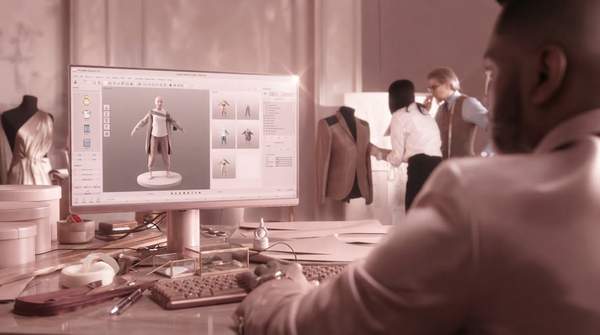
The final stage is where concepts become garments, and where AI currently steps aside. Rachel Lee's bridge workflow moves selected concepts into Illustrator for flat drawing or CLO 3D for virtual prototyping—"this is where you make the design actually constructible." The concept is then translated into manufacturing specifications via tech packs, with tools like Techpacker now using AI to auto-populate measurement charts and BOM lists from flat drawings. A first sample is produced, compared against the AI concept, and the gaps documented as a feedback loop that improves future prompting.
3D design-software maker Browzwear makes the case bluntly: while AI excels at generating quick initial ideas, professional product development software is critical for refining those concepts into production-ready garments, because precision in pattern-making, virtual fitting, and detailed rendering is non-negotiable. Virtual fit validation can confirm that garments will fit properly before production, preventing costly revisions and reducing the need for physical samples. AI tools are not finished design tools; they require integration with existing professional software to close the loop.
The Generative AI Fashion Design Workflow Model
The table below consolidates the three stages into a single framework a design team can apply directly, mapping each stage's activity, the division of labor, and the tools involved.
| Stage | Primary Activity | AI's Role | Designer's Role | Key Tools |
|---|---|---|---|---|
| 1. AI-Powered Ideation | Generating diverse concepts, mood boards, and variations from text or images | Ideation accelerator; produces photorealistic imagery with fine detail like fabric texture and draping, plus diverse variations from one prompt | Writes prompts, explores widely, treats outputs as starting points rather than finished designs | Text-to-image generators; Cala's DALL-E-based tool |
| 2. Human-Led Curation & Refinement | Selecting and steering the strongest AI outputs | Provides raw candidates; cannot judge brand fit, commercial potential, or manufacturing feasibility | Curates based on brand fit and feasibility; guides and optimizes the final output | Prompt iteration within generative platforms |
| 3. Digital-to-Physical Bridge | Refining concepts into production-ready garments | Limited; can assist with tech pack elements such as auto-populating measurement charts and BOM lists | Flat drawing, virtual prototyping, fit validation, tech pack creation, sampling and feedback | Illustrator, CLO 3D, professional digital product development software, Techpacker |
Read sequentially, the model shows a deliberate narrowing: many AI concepts become a few curated directions, which become one constructible design. The tools column also reveals the market's structure—generative platforms feed the front of the pipeline, while established professional software owns the back end.
Types of Generative AI Tools for Fashion Designers
The tool landscape splits into two categories, per Plug and Play's market analysis. The first is existing design tools that integrate generative AI as an added feature—Cala, which uses DALL-E technology, is the cited example. The second is emerging companies purely focused on asset generation, such as cre[ai]tion and Raspberry AI. These categories serve different purposes within the workflow: integrated platforms can sit closer to a brand's existing process, while pure asset generators maximize ideation throughput.
Real-world adoption shows the augmentation pattern in practice. Tommy Hilfiger has run an AI-assisted design collaboration with IBM and FIT, and Google and Zalando's Project Muze explored AI-generated design. The industry's use of generative AI remains early—Plug and Play notes it has been less than two years since tools were developed and commercialized—and the examples available are illustrative rather than an exhaustive survey. Notably, the cited tools address ideation and concept work; none of the evidence shows AI independently producing complete, production-ready 3D models without human intervention.
Integrating AI: A Collaborative Future for Fashion Design
Designers should adopt a structured, three-stage workflow for generative AI, leveraging its power for accelerated ideation while maintaining human oversight and utilizing professional 2D/3D software for production readiness. The evidence is consistent on the boundary: AI multiplies options at the concept stage, humans decide what is worth making, and professional software makes it manufacturable. Successful integration will be indicated by a measurable increase in design concept generation efficiency and a seamless transition of AI-assisted concepts into production-ready digital assets within existing design pipelines. For teams starting now, the concrete first milestone is simple: run one collection's ideation through a generative tool, track how many curated concepts reach virtual prototyping in CLO 3D or equivalent DPD software, and use the sample comparison to sharpen the next round of prompts.
Sources
- How to Use Generative AI in Your Fashion Design Workflow — Vistoya
- How Brands Use Gen-AI in Fashion to Design Their Collections — Plugandplaytechcenter
- Generative AI in the Fashion Industry: Are you Embracing it? — Fashion and Textile Business Excellence Cooperative
- Generative AI in Fashion: Complete 2026 Guide — Stytrix
- AI in Fashion Design: Transforming Creative Workflows Responsibly — Browzwear