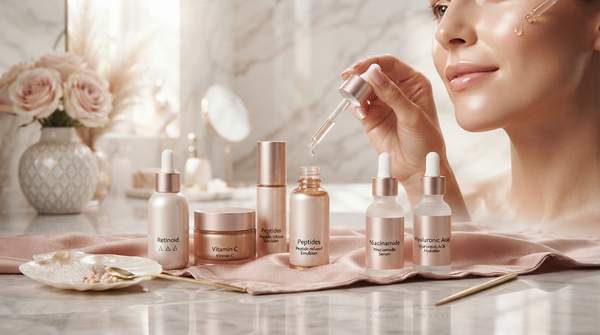
If you want skincare that actually fights visible aging, the science points to a short list of ingredient classes: retinoids, antioxidants like vitamin C, peptides, niacinamide, and hyaluronic acid. A scientific review of anti-aging cosmeceuticals identifies retinoids, peptides, and antioxidants as the central ingredient classes in the field, each working through a distinct, documented mechanism. Dermatologists echo that consensus: retinoids in particular are described as the gold standard because, as chemist Michelle Wong puts it, "there's abundant evidence that they work for common skin-aging concerns like wrinkles and dark spots."
Retinoids: The Gold Standard for Skin Renewal
Retinoids are compounds derived from vitamin A, and their reputation rests on two well-documented actions: they stimulate collagen synthesis and accelerate epidermal turnover. Debra Jaliman, an assistant clinical professor of dermatology at the Icahn School of Medicine at Mount Sinai, explains the payoff: "That improves skin texture, softens lines, and fades discoloration." Few ingredient classes address as many signs of aging at once.
Not all retinoids are equal in strength or oversight. Wong notes that prescription retinoids "are more regulated and reliable than cosmetic retinoids," because randomized trials must demonstrate that they work before they reach the pharmacy. Over-the-counter retinol sits at the gentler end of the spectrum, which makes it the practical entry point for most people. Brand-published guidance on drugstore-versus-luxury comparisons adds that the difference between an inexpensive and a premium retinol often comes down to delivery systems rather than the retinol molecule itself.
Antioxidants: Protecting Against Environmental Damage
Antioxidants work differently from retinoids: rather than driving cellular renewal, they neutralize free radicals and reduce oxidative damage, the environmental stress that accumulates as photoaging. Vitamin C is the best-known example, and the scientific review classifies it squarely within this protective mechanism.
Its visible benefits cluster around tone rather than texture. Practitioner guidance in the skincare retail space describes vitamin C as brightening, smoothing, and improving skin tone while defending against free radicals, and notes that it is often paired with ferulic acid and vitamin E for antioxidant protection. That same source flags the class's central weakness: vitamin C oxidizes quickly and loses potency, so formulation and stability matter more than price. A beautifully packaged serum that has turned color may be doing very little.
Peptides and Niacinamide: Supporting Skin Structure and Barrier
Peptides address the structural side of aging. According to the cosmeceutical review, they signal fibroblast activity and promote matrix repair, supporting the skin's own regenerative processes. Practitioner guidance frames their target concern as firmness, making peptides the class to look for when sagging and loss of resilience, rather than surface discoloration, is the primary worry.
Niacinamide plays a different supporting role. Brand-published ingredient guidance credits it with skin barrier support and fine-line reduction, alongside reducing inflammation and redness. Its value is multifaceted rather than dramatic: it builds a more resilient, even-toned complexion, which makes it especially useful for sensitive or reactive skin that cannot tolerate stronger actives. Hyaluronic acid rounds out the evidence-backed list as a hydration ingredient, contributing plumpness rather than renewal.
Comparative Guide: Matching Ingredients to Your Anti-Aging Concerns
The table below distills the evidence into a single reference, mapping each ingredient class to its documented mechanism, the aging concern it best addresses, and the strength of scientific support behind it. Use it to translate your primary concern into the ingredient class worth seeking on a label.
| Ingredient Class | Primary Mechanism | Best For (Aging Concern) | Strength of Evidence |
|---|---|---|---|
| Retinoids (e.g., retinol) | Stimulate collagen synthesis and accelerate epidermal turnover | Fine lines, wrinkles, dark spots, texture | Strong; the widely cited "gold standard" with extensive clinical backing |
| Antioxidants (e.g., vitamin C) | Neutralize free radicals and reduce oxidative damage | Dark spots, uneven tone, protection against photoaging | Good support; effectiveness depends on stable formulation and concentration |
| Peptides | Signal fibroblast activity and promote matrix repair | Loss of firmness and elasticity, fine lines | Supported mechanism; supports the skin's structural repair processes |
| Niacinamide | Strengthens skin barrier, reduces inflammation and redness | Sensitivity, redness, fine lines, overall tone | Supported; benefits extend beyond direct wrinkle reduction |
| Hyaluronic acid | Draws and holds moisture in the skin | Dryness, loss of plumpness | Supported for hydration and plumpness |
Read the table as a decision tool, not a shopping hierarchy. If fine lines and discoloration dominate, retinoids carry the strongest evidence. If dark spots and dullness are the concern, a stable vitamin C formulation is the better match. Firmness points to peptides; sensitivity and barrier repair point to niacinamide; dehydration points to hyaluronic acid. Many routines combine classes, since the mechanisms complement rather than duplicate one another.
Practical Guide: Selecting and Using Retinoids Effectively
Because retinoids are the most powerful and most irritating of these classes, how you start matters as much as what you buy. Practitioner guidance is unambiguous: over-the-counter retinol at any price point still requires gradual introduction, and most people experience redness, dryness, and peeling in the first weeks. Dermatologists commonly recommend beginning with lower concentrations and increasing frequency slowly so the skin can acclimate.
On choosing between camps, Wong's distinction is the practical one: prescription retinoids are more regulated and reliable because their efficacy is proven in randomized trials, while cosmetic retinoids offer a gentler, more accessible starting point. Brand-published comparisons suggest retinol as the beginner's form, retinaldehyde as a moderate step up, and tretinoin as the prescription option for severe concerns.
Finally, resist the urge to stack everything at once. Dermatologist Levin, quoted by Wirecutter's Jennifer G. Sullivan, observes that "people become obsessed with more anti-aging ingredients, more actives, more exfoliants," when it is often better to pare back and focus on replenishing what skin loses with age. Practitioner guidance also sets a realistic timeline: expect roughly 8 to 12 weeks of consistent use before visible wrinkle improvement, and remember that results vary with the full formulation, concentration, and your individual skin type. This article covers ingredient classes, not specific products, and is not medical advice; a dermatologist can personalize these choices.
Making Informed Skincare Choices: Your Next Steps
Prioritize products containing retinoids, antioxidants like vitamin C, and peptides, selecting based on your primary skin concern and introducing new actives gradually rather than all at once. The measurable indicator of success is simple: you can identify a suitable ingredient class for your specific concern and describe the initial steps for incorporating a retinoid, starting with a low concentration, using it sparingly at first, and planning for an acclimation period of redness and dryness before results emerge over the following weeks.
Sources
- MDPI
- Which anti-aging skincare ingredients work best? — Center for Science in the Public Interest
- Drugstore vs Luxury Anti-Aging Ingredients — SeoulCeuticals
- We Cut Through the Anti-Aging Hype to Find Skin Care You’ll Actually Use — Wirecutter: Reviews for the Real World