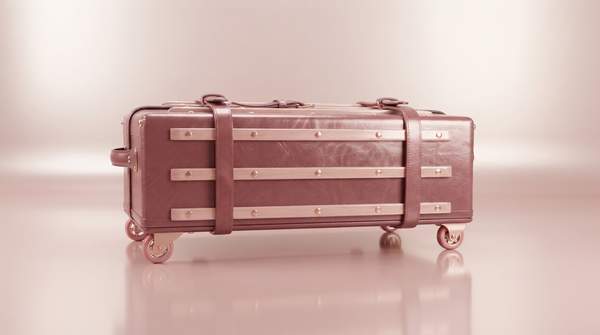
The luxury travel trunk earned its place in culture through a chain of design decisions, each answering a concrete change in how people moved. The domed leather-topped trunk suited horse-drawn travel; the flat-topped, stackable trunk answered railways and steamships; specialized wardrobe trunks and signature canvases then transformed a packing crate into a marker of wealth. Louis Vuitton sits at the center of that story, though he did not work alone.
The Dawn of Luxury Travel: Trunks Before Louis Vuitton
Before the railway age, the trunk was a purely functional object built to survive bad roads and worse weather. The most common form was the dome-top, sometimes called the camelback, whose rounded profile had two jobs: it let rainwater drain off during carriage journeys, and it discouraged stacking. According to Channing Gardner, writing on the history of vintage trunks for The Griffin Mall, that rounded top also ensured the trunk rode on top during transport—deliberately—so its owner's luggage would not be buried beneath anyone else's.
I find that detail telling. Even in the early nineteenth century, before any designer thought of luggage as branding, the shape of a trunk was already communicating hierarchy. Dome-top trunks were typically covered in embossed tin, leather, or canvas and fitted with ornate hardware, an early hint that decoration and status traveled together. As Sophie Hannam notes in her history of the Louis Vuitton trunk for Homes and Antiques, wealthy nineteenth-century travelers considered it "of maximum importance" to move an array of glamorous outfits, jewels, and toiletries by land or sea—an expectation the old dome-top form could only awkwardly meet.
Louis Vuitton's Revolution: The Flat-Topped Trunk and New Materials
Vuitton's own career traced the social ladder the trunk served. By 1853, after apprenticing with the leading box-maker Monsieur Maréchal, he had become an official trunk-maker and personal packer to Empress Eugénie, consort of Napoleon III and a recognized leader of fashion—the auction-world commentary Barnebys records this progression in its collecting guide.
The pivotal moment came in 1858, when Vuitton introduced a trunk with a flat top and bottom. The design solved a genuinely new problem: trunks could now be stacked efficiently in the holds of steamships and the luggage vans of trains. His early trunks were covered in Trianon canvas, a grey, water-resistant, odorless, and extremely hard-wearing fabric. In Christie's account of Vuitton's signature materials, the choice was practical first—durability and protection for contents—but the distinctive surface quickly became recognizable. By 1867 Vuitton was exhibiting at the Exposition Universelle in Paris, winning a bronze medal and international acclaim.
Evolving Designs for the Grand Tour: Wardrobe Trunks and Signature Canvases
Success bred imitation, and imitation pushed design toward identity. As the popularity of Vuitton's trunks grew, so did the number of copies, Christie's explains. The company's response in 1872 was its striped canvas—an early instance of a pattern functioning simultaneously as decoration and as an anti-counterfeit device.
The 1875 wardrobe trunk changed packing itself. Rather than folding garments flat, it let clothes hang vertically in hanging compartments, with drawers for accessories—keeping wardrobes wrinkle-free across extended journeys. Gardner's history describes these as "the epitome of luxury travel," catering to wealthy travelers who wanted convenience and style on the move; some even included fold-out ironing boards. The trunk was no longer a container. It was a mobile dressing room, purpose-built for the grand tour and the long ocean crossing.
Timeline of Luxury Trunk Innovations and Travel Evolution
| Date/Era | Innovation or Material | Purpose and Impact on Travel | Key Proponent |
|---|---|---|---|
| Pre-1858 | Domed leather tops | Let rainwater drain off in carriage travel; discouraged stacking, keeping the owner's trunk on top | General trunk-making trade |
| 1858 | Flat-topped, stackable trunk | Allowed efficient stacking on trains and steamships, replacing the domed form | Louis Vuitton |
| Mid-19th century | Trianon canvas | Grey, water-resistant, odorless, hard-wearing cover protecting contents in transit | Louis Vuitton |
| 1867 | Exposition Universelle showing | Bronze medal and international acclaim for the flat-topped design | Louis Vuitton |
| 1872 | Striped canvas | Distinctive pattern introduced against counterfeiting and to cement brand identity | Louis Vuitton |
| 1875 | Wardrobe trunk | Hanging compartments and drawers kept clothing wrinkle-free on extended journeys | Louis Vuitton |
| 1896 | LV Monogram canvas | Created by Georges Vuitton to protect the brand from copies; became a symbol of luxury in its own right | Georges Vuitton |
Read in sequence, the pattern is unmistakable: each form followed a transport revolution or a commercial threat. The dome belonged to the carriage; the flat top belonged to the railway and the liner; the patterned canvas belonged to a marketplace crowded with imitators. Design innovation was never decorative here—it was a running answer to the question of how, and for whom, people traveled.
From Utility to Icon: The Trunk as a Status Symbol
How did a box become a badge? Two things happened at once. First, the makers wrapped practical advances in unmistakable craft: Tim Bent of the London antique luggage shop Bentleys, quoted in Homes and Antiques, describes Vuitton trunks as "deeply reminiscent of travel on the great ocean liners like the SS Normandie, and leisurely journeys on the Orient Express," praising "the craftsmanship and materials" as exceptional. The trunk absorbed the glamour of the journeys it made possible.
Second, ownership itself became expressive. Wealthy travelers had their trunks custom-made, with intricate designs and personalized details, as HuangRong's history of travel bags for WITZMAN recounts—an indication of social standing central to the elite travel experience. A wardrobe trunk announced that its owner possessed a wardrobe worth hanging. The trunk's modern afterlife completes the arc: no longer essential for travel, vintage trunks are now coveted as collectibles and decorative pieces, and Christie's is auctioning the largest single-owner collection of Louis Vuitton trunks ever offered, in two 2025 sales in Paris.
The Enduring Legacy of the Luxury Travel Trunk
The luxury travel trunk's transformation from a functional necessity to a coveted status symbol was a direct result of continuous design innovation responding to evolving travel needs and the strategic cultivation of brand identity. That is the decision the history supports, and it can be checked against a concrete indicator: continued market demand for vintage luxury trunks—Christie's record-breaking single-owner sales in 2025 are the clearest current example—together with the enduring influence of flat-topped forms, protective canvases, and hanging wardrobe organization on high-end luggage today.
Sources
- The History and Modern Charm of Vintage Trunks — The Griffin Mall
- History of the Louis Vuitton trunk — Homes and Antiques
- Vintage Luggage & Trunks: Where to Begin — Barnebys
- Louis Vuitton trunks collecting guide — Christies
- The Evolution of Travel Bags: From Antique Trunks to High-Tech Wonders — WITZMAN