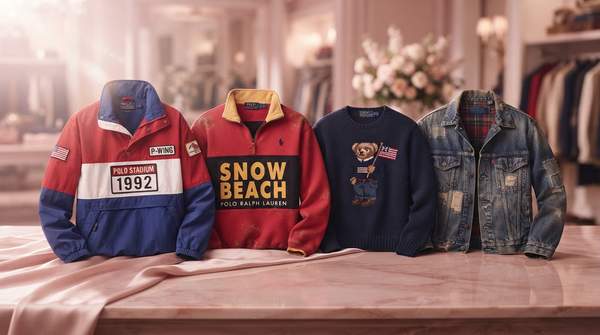
If you want to collect vintage Polo Ralph Lauren, focus on four cultural moments: Stadium (1992), Snow Beach (1993), the early Polo Bear (1991 onward), and Polo Country from the late 1980s. The catch is that not every piece wearing those graphics is an original, and originals carry the value. Here is how the lines differ, why collectors want them, and what to check before you pay.
The Enduring Appeal of Vintage Polo Ralph Lauren
Part of what makes vintage Polo so collectible is that the brand itself keeps proving the point. Ralph Lauren revisited Stadium for its 25th anniversary in 2017, a return that demonstrates the continuing cultural and commercial influence of the original designs, as one resale-focused guide to New York's vintage market notes. That revival cut both ways: it kept the archival aesthetic alive, but it also flooded the market with pieces that look similar to 1992 originals without being them.
The market also splits sharply by tier. A vintage resale data guide, drawing on recent eBay, Poshmark, Depop, and Mercari sold listings, describes the 1992 Stadium collection and the Snow Beach pullover as some of the highest-flipping vintage pieces in thrift reselling. Meanwhile, an ordinary secondhand Ralph Lauren button-down may sell for only a modest premium over thrift pricing. The gap between those two outcomes is where the collector's homework lives.
What drives the premium is cultural weight. The early-1990s Snow Beach designs combined winter-sports references with distinctive graphics and bright colors, and their popularity among collectors became closely tied to New York hip-hop history—particularly Raekwon's now-famous jacket. Stadium carries a comparable aura as the collection that defined an era of Polo sportswear design. Rarity of the original runs, not the motifs themselves, is what separates a grail from a graphic.
Iconic Collections: A Collector's Comparative Guide
The table below compares the most sought-after lines across their release era, defining visual language, and the primary driver of collector demand. One rule applies to all of them: the release year marks the design's origin, not the production date of any given garment bearing that artwork.
| Collection | Original Release | Key Design Elements | Collector Appeal / Rarity Driver |
|---|---|---|---|
| Stadium | 1992 (revived 2017 for the 25th anniversary) | Bold sportswear graphics; placement, proportions, colors, and execution of the artwork are the distinguishing markers | Cultural moment of early-1990s Polo; originals are scarce and not interchangeable with later reproductions |
| Snow Beach | Fall 1993 (documented 2018 return) | Winter-sports references, distinctive graphics, and bright colors | Tie to New York hip-hop history, notably Raekwon's jacket; reported among the highest-flipping vintage pieces |
| Polo Bear | 1991 debut, with revivals documented in 2013 and 2017–2018 | Bear mascot knitwear designs; each Bear design and edition must be dated individually | A rare original Bear sweater may command hundreds or thousands of dollars, depending on authenticity, condition, size, and demand |
| Polo Country | Late 1980s | Outdoor and country-life motifs within the broader archival Polo era | Early provenance within the pre-Stadium archival window |
Reading the table this way helps you prioritize. If your interest is hip-hop provenance, Snow Beach is the line where that cultural association is strongest. If it is the sportswear graphic era, Stadium is the archetype. If mascot knitwear appeals, the Bear requires the most granular dating, because later products also use the name and label artwork, so the individual design and edition—not the Bear itself—determine what you own.
Authenticating Your Vintage Polo Finds
Authentication starts with separating three categories: original releases, official reissues, and contemporary garments featuring archival graphics. A dating guide built on Ralph Lauren's own documented history is blunt about this—original releases and later revivals must be separated, and design dates and garment dates are different things. Ralph Lauren itself identified a 2017 shirt bearing Stadium 1992 artwork, and it documented both the Fall 1993 Snow Beach originals and the 2018 return.
When examining a piece, the resale market guide recommends checking the collection-specific graphics first: placement, proportions, colors, and execution of Stadium, Snow Beach, P-Wing, or Polo Bear artwork. For Snow Beach specifically, match the exact colorway, materials, and hardware against release documentation, since the 2018 return revived the aesthetic with its own construction. For Stadium, compare the full label set and construction against the 2017 reissue to confirm which era you are holding.
Condition comes next: look for repaired seams, damaged knitwear, replacement zippers, fading, shrinking, and modifications that affect value. Then apply the most important caution in the field—authenticity cannot be proven by a single label, fabric detail, or production country alone, as Ralph Lauren has utilized diverse manufacturers and construction methods over time. For valuable garments, it is crucial to compare multiple verifiable characteristics and inquire with the seller about provenance, return policies, and any available authentication processes before making a purchase.
Beyond Polo: Understanding Ralph Lauren's Sub-Brands
The Polo-line capsule collections above sit inside a much larger ecosystem, and knowing the boundaries prevents expensive category errors. According to the brand-history timeline, Double RL (RRL) launched in 1993—the same year as the Fall Snow Beach collection—with its own founding date and design meaning. RRL is the niche, Americana-inspired arm of the label, pursued by a different collector profile than the sportswear-graphics crowd.
The timeline also marks the distinct trajectories of the brand's other lines: Purple Label and the U.S. launch of Polo Jeans Co. arrived in 1995–1996, and RLX debuted in 1998 as technical sportswear that requires its own comparison references. None of these carry the same collector logic as an original 1992 Stadium piece or a Fall 1993 Snow Beach pullover. If your goal is the culturally celebrated early-1990s menswear, the collectible territory is the Polo line itself—Stadium, Snow Beach, early Bear, and the late-1980s archival era before them.
Making Informed Vintage Polo Collecting Decisions
Prioritize collecting original pieces from the iconic collections—Stadium (1992), Snow Beach (Fall 1993), early Polo Bear (1991 onward), and Polo Country—while authenticating each item against known release details and explicitly distinguishing it from documented reissues like the 2017 Stadium revival and 2018 Snow Beach return. Expect the premium tier to sit at hundreds or thousands of dollars for identifiable Stadium-era garments, desirable Snow Beach pieces, and rare original Bear sweaters, with ordinary vintage Polo trading far below that.
The measurable indicator of success is the confirmed identification of an original, highly collectible vintage Polo Ralph Lauren garment—verified through multiple authentication checks rather than any single label or detail. Before your next purchase, request the seller's confirmation of original-release status in writing, match the graphics, colorway, materials, and hardware against documented release references, and inspect condition for alterations. Each of those checks is a concrete, observable gate a collector can pass or fail on a specific garment.